



No products in the cart.
Ivermectin for scabies
What Is Scabies?
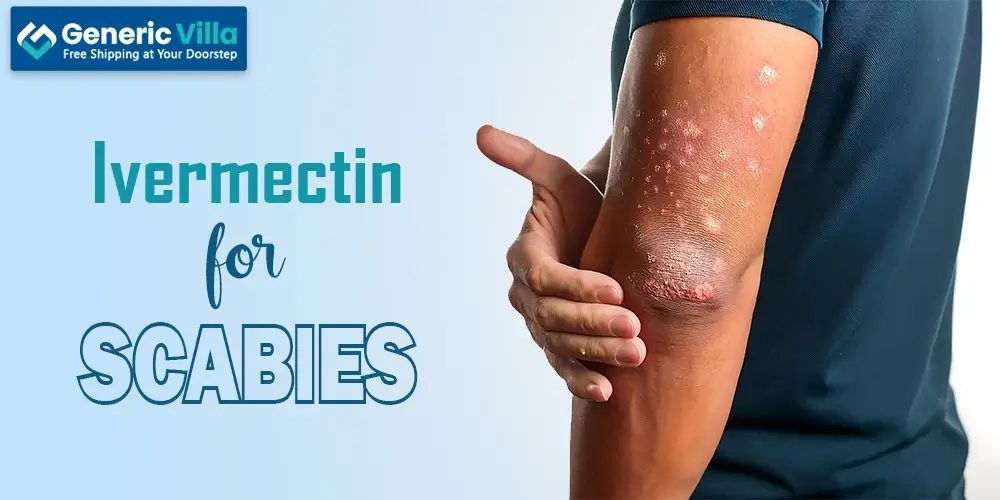
Scabies is one of the most contagious skin infestations caused by tiny mites called Sarcoptes scabiei. These microscopic mites burrow into the upper layer of the skin, where they can live, feed and lay eggs. Scabies can affect anyone and can spread rapidly through close skin-to-skin contact.
In some cases ivermectin for scabies in cats can also be prescribed by veterinarians to help kill mites that cause mange and severe skin irritation.
It is important to note that scabies is not caused by poor hygiene; even a clean individual can get infected if they come into contact with someone who has the infestation. Without treatment, scabies can continue spreading among
- family members
- partners
- roommates
- or people living in crowded environments.
This condition usually causes intense itching and a rash that becomes worse at night. The commonly affected areas are wrists, fingers, elbows, waistline, underarms, buttocks, and the genital area. But to control, ivermectin for scabies is available in the market and may be prescribed by specialists, and can be effective in certain cases
What Causes Scabies?
Human itch mites spread scabies through close skin contact. Alongside these are several factors that increase the risk of scabies transmission, including:
- In the case of physical contact with people.
- Living in crowded environments
- Sharing beddings, towels, or clothing
- Nursing home or care facilities
- Dormitories or hostels
- or Sexual contact with an infected partner
Several factors can increase the spread of scabies. This is where the desired ivermectin dose for scabies is suggested by a specialist to control the rapid spread and improve overall health.
How do you get scabies?
Scabies usually spreads through direct and prolonged skin-to-skin contact. Sometimes, even a handshake can also infect people.
Sleeping in the same bed or close physical contact increases the risk of transmission. As individuals can get scabies through living with an infected person, through sexual activity, sharing clothes, towel or even bedsheets, living in crowded conditions, or even within Childcare centers or nursing facilities.
The use of ivermectin for scabies in dogs is also commonly given under veterinary supervision to treat mange mites, reduce itching, and improve skin healing.
Common Symptoms of Scabies
Most people develop symptoms within 2–6 weeks after exposure. However, people previously infected may develop symptoms like-
- Rashes
- sores from scratching
- intense itching
- irritation in the skin between fingers and toes
- rash around wrists
- waist, chest
- or genitals or
- There can be thin burrow lines on the skin.
What Is Ivermectin
The use of oral ivermectin for scabies is an antiparasitic medication which is commonly available for the treatment of infections caused by parasites and mites. This can be due to certain conditions-
- scabies
- strongyloidiasis
- river blindness
- and certain worm infections.
How does ivermectin work for scabies?
Ivermectin attacks the nervous system of scabies mites. This majorly binds to the parasite’s nerve and even muscle cells, thereby causing death/paralysis.
The medicine helps by killing the active scabies mites, reducing the spread of infestations, improving itching and rashes gradually, and treating difficult and widespread infestations.
Though the use of Ivermectin cream or the oral dose kills mites effectively but might not destroy all eggs completely.
Ivermectin for scabies dosage
The ivermectin for scabies dosage for humans for scabies is generally based on the weight of the body, however, a common dose is-
200 mcg/kg body weight and has to be taken as a single dose.
Doctors usually recommend a second dose after 7–14 days.
How to take ivermectin for scabies
People asking how to use ivermectin cream for scabies have to be done exactly as prescribed by the doctor and not own.
- Take the medicine on an empty stomach with water.
- Follow the second dose your healthcare specialist advises.
- Must keep your clothes, towels, and even bedding the same day.
- Sometimes, a doctor may combine ivermectin with topical treatments for severe infestations.
Ivermectin vs Topical Scabies Treatments
- There are several topical medications that are used for the treatment of scabies, especially permethrin cream.
- Ivermectin has the advantage that it is an oral tablet and is easy to consume.
- Quite useful for large outbreaks.
- Easier for elderly or disabled patients.
- Helpful in crushed scabies.
Topical treatment advantages
- There is a need for direct application to the affected skin.
- Often considered as the first line of therapy.
- Effective for mild cases as well.
Common topical treatment
This can include the use of Permethrin 5% cream, Benzyl benzoate lotion, Sulfur ointment and even Crotamiton cream.
What to expect after taking ivermectin for scabies
- Many people can expect an instant relief, but recovery usually takes time. After treatment is done, you can notice-
- Itching gradually decreases after treatment.
- Rashes slowly fade away.
- There is less skin irritation over 1-4 weeks.
- Dead mites clearing from the skin
In some cases, itching may temporarily continue after successful treatment because the immune system still reacts to dead mites and debris.
How long does it take for ivermectin to kill scabies
Ivermectin begins affecting the mites within an hour after taking the medication. However, most of the active mites die within 24–48 hours. Some of the symptoms might take a few days to weeks, even.
Eggs can survive initially.
In some cases, a second dose might be required.
How long does ivermectin stay in your system for scabies
Ivermectin has a half-life of approximately 18 hours, but it traces can remain in the body for several days. Even after the drug leaves the body, the immune system responds to the healing process, which might take some time.
Side Effects and Safety of Ivermectin
- Fatigue
- Headache
- Dizziness
- Mild nausea
- Diarrhea
- Stomach discomfort
Preventing Scabies Reinfection
Treating the infection may not alone prevent the recurrence if mites remain in the environment.
Do wash clothes/bedding to keep away from infection.
Dry items on high heat.
Vacuum mattresses and furniture
When to See a Doctor
- When a new burrow appears.
- Several rashes develop
- Crusted scabies is suspected.
- When a secondary skin infection occurs.
- Symptoms worsen despite medication
Why Itching Continues After Treatment
Persistent itching after scabies treatment is quite common, but it does not mean it is a treatment failure. The itching may continue because the dead mites remain in the skin temporarily, the immune system is still reacting, and skin inflammation needs time.
The condition is sometimes called post-scabies itch and may last several weeks.
Is Ivermectin FDA-approved for Scabies
The FDA approves ivermectin for several parasitic infections, but oral ivermectin is not specifically FDA-approved for scabies treatment. However, doctors commonly prescribe it “off-label” for scabies because medical studies and clinical experience show it to be effective, especially in difficult cases. Off-label uses are quite common when supported by evidence and even physician judgment.
Is one dose of ivermectin enough for scabies
In many cases, one dose might not eliminate scabies because eggs can survive the first treatment. Most of the treatment plans recommend one initial dose, a second dose after 7–14 days, as the second dose helps to kill newly hatched mites before they spread again.
The purchase of Ivermectin, either for humans, dogs or cats, can be done with Genericvilla online. Referring as the reputed online pharmacy store, we have different strengths of Ivermectin to be given as per the requirement.
Medicines should only be used under medical supervision. Delivery is done across countries, with fast shipping, following regulations, and with customer support.
Conclusion
Ivermectin is proven to be an effective oral treatment for scabies, particularly in severe, widespread, or difficult-to-treat cases. The medicine works by paralysing and killing scabies mites, thereby helping to reduce itching and skin irritation over time.
Although it has been found that symptoms may not disappear immediately, proper treatment, combined with environmental cleaning and prevention measures, can successfully eliminate the infestation
PUBLISHED BY

Mary Hill
Dr. Marry Hill is one of the amongst and best urologists and content writer, who has treated hundreds of USA as well as international patients. She loves to write content based on Men’s Health problems like Erectile Dysfunction and Sexual Disorders. You can connect on Twitter: @maryhil14623979. View all posts by Mary Hill
